A2A: the quiet protocol that lets anything talk to anything
Agent-to-agent communication is becoming the common language of the AI era — and it is far more than AIs talking to AIs. Here is why it is a big deal, and why automotive is the first industry to plug in.

Alex Yankouski
Co-founder, Lumika
Every once in a while, a piece of plumbing gets built that quietly changes what is possible on top of it. TCP/IP did it for computers. HTTP did it for web pages. I think A2A is doing it for agents — and most people have not noticed yet.
Let me explain what it is, why it is genuinely exciting, and what it unlocks.
What A2A actually is
A2A stands for Agent-to-Agent. It is an open standard for letting software agents — the AI assistants and bots showing up everywhere now — discover each other and work together, even when they were built by completely different companies on completely different tech.
Google announced A2A in April 2025 with a group of launch partners, and a couple of months later handed it to the Linux Foundation so that no single company owns it. Since then it has grown fast: more than 150 organizations now back it, including Google, Microsoft, AWS, Salesforce, SAP, ServiceNow, and IBM.
The idea is simple but powerful. Before A2A, if you wanted Agent A to hand work to Agent B, someone had to build a custom connector between that exact pair. Every new pairing meant new glue code. A2A replaces all of that with one shared language. An agent publishes a small "agent card" that describes what it can do, and any other agent can read it, ask for help, and get a result back — without either side exposing its private code, data, or memory.
It runs on boring, proven web technology (HTTP, JSON-RPC, server-sent events), so it drops into existing systems easily. And it pairs naturally with MCP, the Anthropic standard you may have heard of: MCP connects an agent to its tools and data, while A2A connects an agent to other agents. One is how an agent reaches its hands. The other is how it talks to its peers.
The cool part: it is not just AIs talking to AIs
Here is where it gets interesting, and where I think most coverage undersells it.
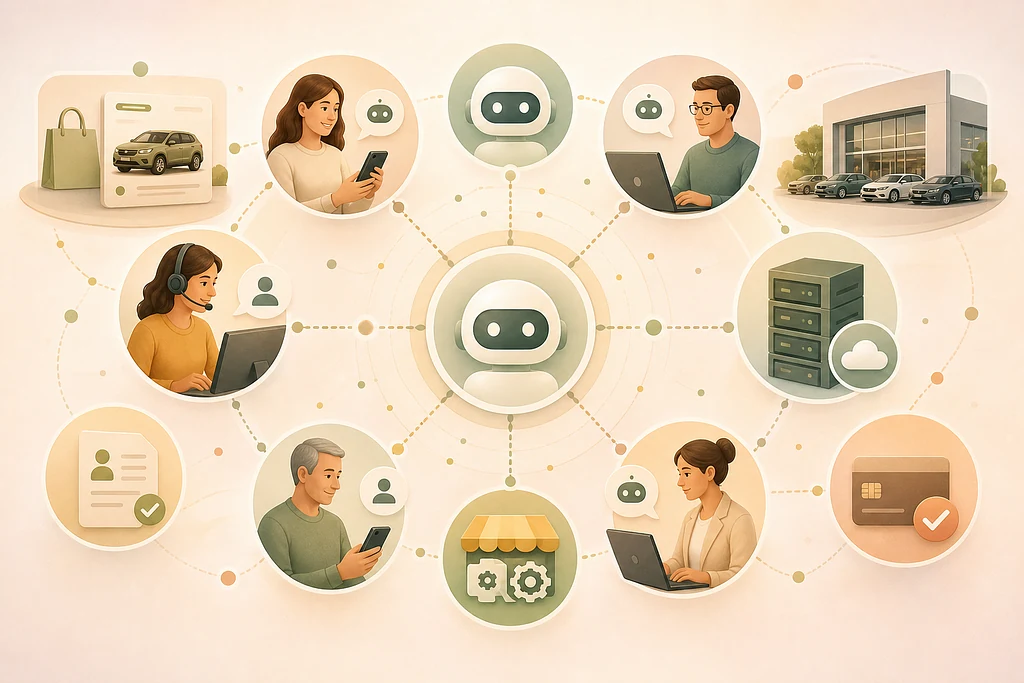
The word "agent" is doing a lot of quiet work. An agent is just something that can send and receive messages in this shared language. And that something does not have to be an AI. It can wrap a human. It can wrap an old API. It can wrap an entire company's backend.
Once you see that, the protocol stops being "AIs talking to AIs" and becomes a universal adapter between every kind of participant:
- AI to AI — the obvious one. Your shopping agent asks a dealership's agent to find a car. Two AIs, working together.
- Human to AI — you ask an assistant to do something, and it carries your request into the agent network on your behalf.
- AI to Human — an agent hits a decision only a person can make, so it reaches a human and waits for the answer.
- API to API — two backend systems talk as agents, negotiating and handing off tasks instead of being hand-wired together.
- Human to API — a person reaches a backend service through an agent, in plain language, without ever learning the system.
- API to Human — a backend kicks off a workflow that loops a real person in at exactly the right moment.
- And yes, even Human to Human — two people's agents handling the boring parts (scheduling, paperwork, matching) so the humans only deal with what actually matters.
Same rails. Any sender, any receiver. That is the unlock. We are not just connecting chatbots — we are building what people are starting to call the "Internet of Agents," where a person, a program, and an AI can all be first-class participants in the same conversation.
What that opens up
When anything can talk to anything in a common language, a lot becomes possible that used to be too expensive to build:
- Real delegation. An agent can hand a long, multi-step task to a specialist agent and get updates as it goes. A2A is built for long-running jobs, not just quick replies, and it can pass text, forms, files, and media back and forth.
- Cross-company workflows. Two businesses can let their agents collaborate without a six-month integration project for every single connection.
- Discovery. Agents can find each other by capability, the way the web let pages find each other by link — so your assistant can locate the right service instead of you hunting for it.
- New commerce. Extensions already exist for agents to handle payments, so an agent can not only find the thing but actually transact for it.
This is the part that gets me excited. For twenty years, "integration" meant a human gluing two systems together by hand, one pair at a time. A2A turns that into something closer to a living network, where a new participant just speaks the language and joins.
It is real, and you can build on it today
This is not a slide deck. A2A is shipping.
There are official SDKs in Python, JavaScript, Java, C#/.NET, Go, and Rust — a one-line install in most of them (pip install a2a-sdk, npm install @a2a-js/sdk, and so on). Popular agent frameworks support it out of the box. There are validation tools, a compatibility test kit, piles of sample agents, and even a free DeepLearning.AI short course built with Google Cloud and IBM. The whole thing is Apache-2.0 and open to contributions.
In other words: the horizontal foundation is built, governed, and ready. The hard, lonely work of inventing a new protocol from scratch is done. Anyone can pick it up.
But a horizontal standard is not enough — you need verticals
Here is the catch that took the industry a minute to realize.
A2A defines how agents talk. It does not define what they say in any particular industry. It gives you the grammar — how to send a message, advertise a skill, run a task — but not the vocabulary of, say, car retail, or healthcare, or travel.
If every dealership invents its own way to describe "a 2022 SUV under $30,000 with a clean title and a real out-the-door price," then agents still cannot reliably understand each other, even when both speak A2A. You need an agreed-on set of nouns and verbs for the domain. You need a vertical profile.
That is exactly the gap we set out to fill.
Automotive is the first vertical to close
The Auto Agent Protocol (AAP) is the first complete vertical built on A2A — a strict profile of A2A v1.0 for the car business.
It takes the open A2A foundation and pins down the automotive vocabulary: how an agent asks a dealership about its inventory, how it gets a real and honest out-the-door price, how it pulls details on a single vehicle, and how it sends a real, consented lead. Five clean skills, done right. We just took it to 1.0 — stable and ready to build on — and we are connecting the first 1,000 dealerships for free.
This matters well beyond cars, because it proves the pattern. Take the open horizontal standard everyone shares (A2A), define a tight, honest vocabulary for one industry on top of it (AAP), and suddenly an entire sector is agent-ready — discoverable and answerable by whatever AI assistant a customer happens to use. Automotive is simply first. The same recipe works for any industry that has inventory, prices, and leads.
And the adoption is already real. At Lumika, we speak A2A and AAP natively — connecting dealerships into this agent world while also covering every human channel (voice, text, chat, email, social) around the clock. The protocol is the open road. We are one of the cars already driving on it.
Where this is going
Step back and the shape is clear. The AI assistants people already use are about to start doing real things on their behalf — finding, comparing, booking, buying. For that to work, those assistants need to talk to the businesses, services, and people on the other side. A2A is becoming the language they use to do it.
It is open. It is neutral. It is here. And it does not care whether the thing on either end is a human, an AI, or a fifteen-year-old API — they all get to speak.
Automotive is the first industry to plug in. It will not be the last.
Let's build the agent web. For everyone.
Alex Yankouski
Co-founder, Lumika