How do car buyers like to reach out to dealerships? The data is brutal.
A look at every channel buyers actually use now — phone, text, chat, email, social, and AI — and what the latest research says about each.

Alex Yankouski
Co-founder, Lumika
I build software that sits between car shoppers and dealerships, so I spend a lot of time reading research about how people actually buy cars. Lately the studies all point in the same direction, and the picture is hard to ignore.
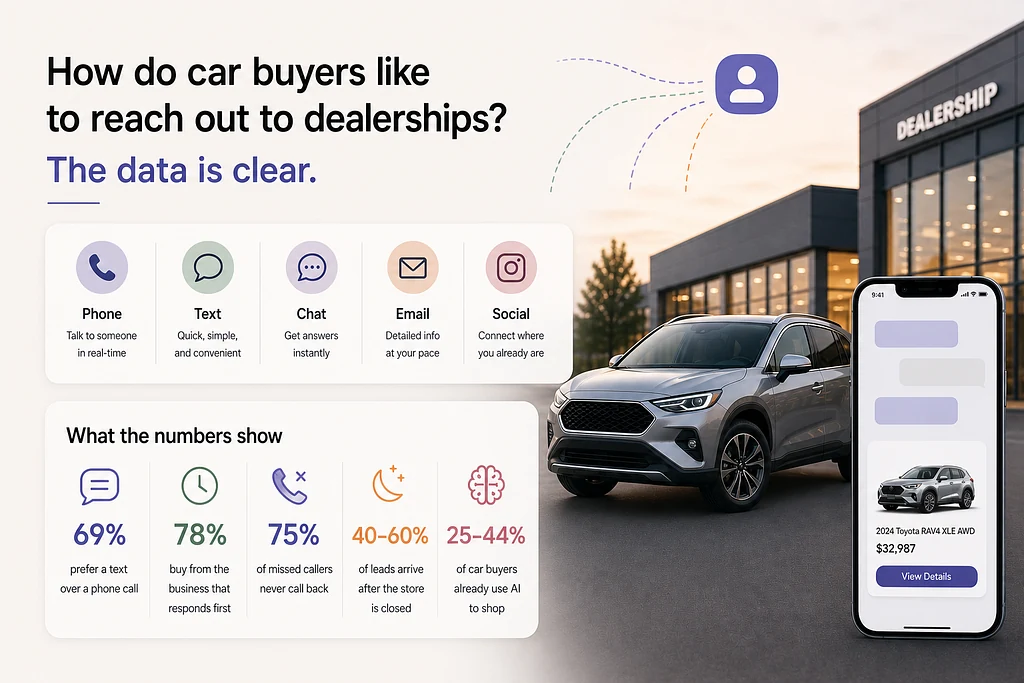
The short version: buyers now reach out across more channels than ever — and they expect a fast, real answer on every one of them. The way most dealerships are set up to respond has not kept up. That gap is where the lost sales live.
Here is what the numbers say, channel by channel.
The phone still matters — it just is not the only door anymore
Start with the phone, because it is the channel dealers lean on hardest.
The phone is not dead. Plenty of serious buyers still call, and a call is often the most ready-to-buy moment you get. But it is no longer where most people start, and for a lot of them it is not their first choice at all.
When Avochato surveyed consumers about reaching a business they did not already know, 69% said they would rather get a text than a phone call. Almost two-thirds (63%) said they would switch to a company simply because it offered texting. More than three-quarters said they do not answer calls from numbers they do not recognize.
Texting backs this up with raw performance: around a 98% open rate and replies in about 90 seconds on average. And dealership research has found for years that among website visitors, a phone call is often the least preferred way to be contacted.
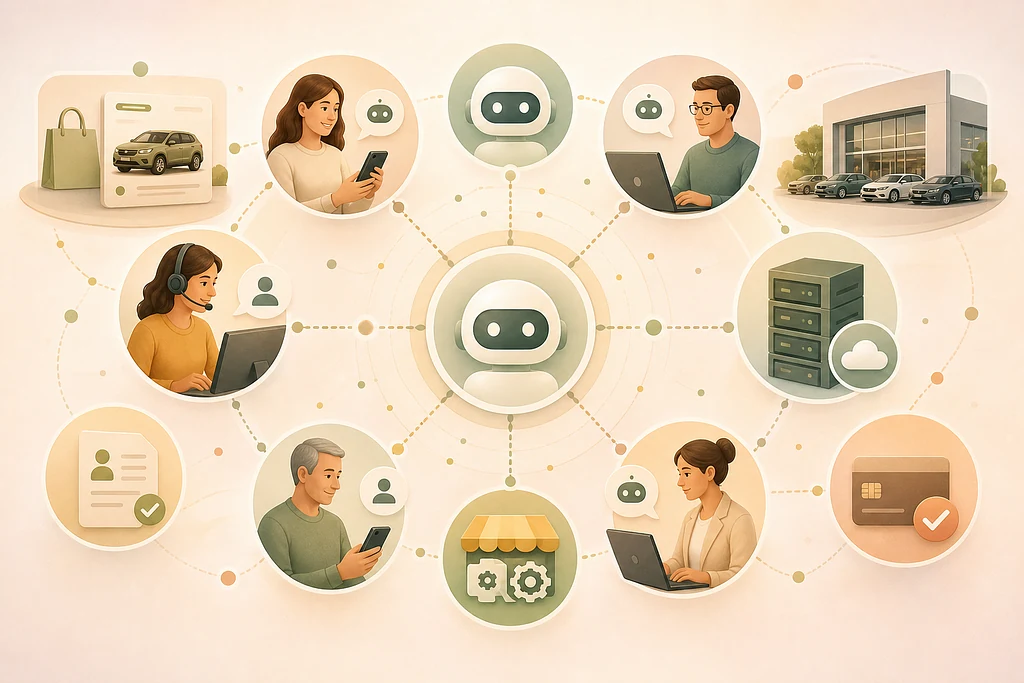
The takeaway is not "drop the phone." It is "do not make the phone your only door." The dealers who win keep the phone and add text, chat, email, and social — so the customer picks the channel, not you. That is the whole idea behind what we build at Lumika: one AI assistant that covers every channel, so no matter how someone reaches out, they get a real answer.
When a channel goes unanswered, the customer just leaves
Offering a channel is only half of it. You have to actually answer it.
The average car dealership misses roughly one in five inbound calls — and some automotive studies put it closer to a quarter. Those are not junk calls. Someone calling a dealership is usually about as ready to buy as a lead ever gets.
And when they do not reach a human, they do not wait. About 75% of callers who do not get through never call back — they call the next dealer instead. One study found 71% immediately contact another business rather than leave a message. Even among those who hold on, analysis across nearly 3,000 stores found about 32% hang up while on hold.
The same is true of every other channel: a web chat nobody mans, a text that sits for hours, an email answered next week. A channel you do not answer is almost worse than not offering it, because now the customer feels ignored.
This is the exact gap an always-on assistant is built to close. An AI that answers every call, text, chat, and message the moment it lands — day, night, weekend, holiday — means no ready buyer ever hits a dead end. That is the core of what Lumika does, across all channels, 24/7.
Speed decides who gets the sale
Whatever the channel, the clock matters more than most dealers think.
78% of customers buy from the business that responds first. Respond within five minutes and you are roughly 21 times more likely to actually connect than if you wait thirty.
The reality falls far short. Foureyes looked at internet leads across 22,500 dealerships and found 43% were mishandled, and one in five stores never personally responded at all. The average store takes most of an hour during business hours, and far longer after — which matters, because 40% to 60% of dealership leads arrive after the store is closed.
Picture it: a customer reaches out at 8 p.m., a competitor answers at 8:01, and your team calls back tomorrow afternoon. The deal was decided overnight. Replying in seconds, on every channel, around the clock, is exactly the kind of thing software is good at — and it flips that math back in your favor.
Gen Z is a preview of every future customer
To see where this is heading, watch the youngest buyers — they are the most demanding version of the trend.
Gen Z does not just lean toward texting — many are genuinely uncomfortable on the phone. Research has found around 90% of Gen Z feel anxious about phone calls. Only 15% of 16-to-24-year-olds consider a voice call their most important way to communicate, and about 74% prefer texting for everyday contact. Two-thirds say they ignore unknown numbers on purpose.
They are not anti-communication — far from it. They live in messaging, chat, and social DMs, and they expect a business to be right there with them. For a dealership, that simply means more channels to cover well: the same conversation might start on Instagram, move to text, and finish on a call. The winning setup handles all of it in one place, without dropping the thread.
Meanwhile, AI quietly became the new front door
Here is the shift that snuck up on the industry while everyone argued about phone scripts.
Buyers are now using AI to shop for cars — fast, and in large numbers.
In 2025, CarEdge found that one in four car buyers already used tools like ChatGPT to research, compare, and even negotiate, and 88% found it helpful. Cars.com put the number higher: 44% of shoppers used AI-powered search, and 97% said AI would influence their decision. Cox Automotive, tracking AI for the first time, saw 19% of all buyers and 25% of new-vehicle buyers using it — and those buyers were the most satisfied of anyone. CarGurus found 80% of shoppers open to AI and 26% already using it. And when people do reach for AI, ChatGPT carries the bulk of it — more than two-thirds of AI car research happens there.
So a quarter to nearly half of your buyers are starting with an AI assistant before they ever touch your website or your phone. AI is now a channel of its own — the newest front door.
But right now, AI is shopping blind
Here is the catch, and it is the reason a big part of my work exists.
The AI your customers use cannot actually see your inventory.
When Consumer Reports tested the major AI tools on car shopping, the assistants confidently recommended cars that do not exist, mixed up model years, and even pointed people to a model that had already been discontinued. Not because the AI is dumb — because it is guessing. It has no clean, direct line to what is really on your lot, at what real price, right now.
That is the missing wire we set out to build. The Auto Agent Protocol is an open standard that lets any AI assistant ask a dealership about its real inventory and send a real, consented lead — in one shared language, with honest pricing written into the rules. It just reached 1.0, and we are connecting the first 1,000 dealerships to it for free. When the AI doing the shopping can talk straight to your store, the guessing stops and your real cars show up.
And buyers are exhausted by the fee games
One more set of numbers, because it explains a lot of the distrust sitting under all of this.
People are tired of the "plus a few thousand dollars in surprise fees" moment at the end. The 2024 KPA Dealership Trust Survey, run with The Harris Poll across 2,000 consumers, found 76% of Americans do not trust dealerships to be honest about price, 86% worry about hidden fees, and 84% believe most dealers fail to be transparent. Nearly one in three discovered fees only after agreeing to a price, and 29% have walked away from a dealership over dishonest pricing. The fees are real money, too: a CoPilot study found the average buyer pays about $640 in extra fees, nearly $12 billion a year across the industry.
This is exactly why honest pricing is written directly into the Auto Agent Protocol: when an AI compares dealers for a customer, the real, out-the-door price is the first thing it asks for. Whoever gives a straight number wins. Whoever plays the bait-price game gets flagged.
What all of this adds up to
Put the studies side by side and they tell one clear story about the 2026 car buyer:
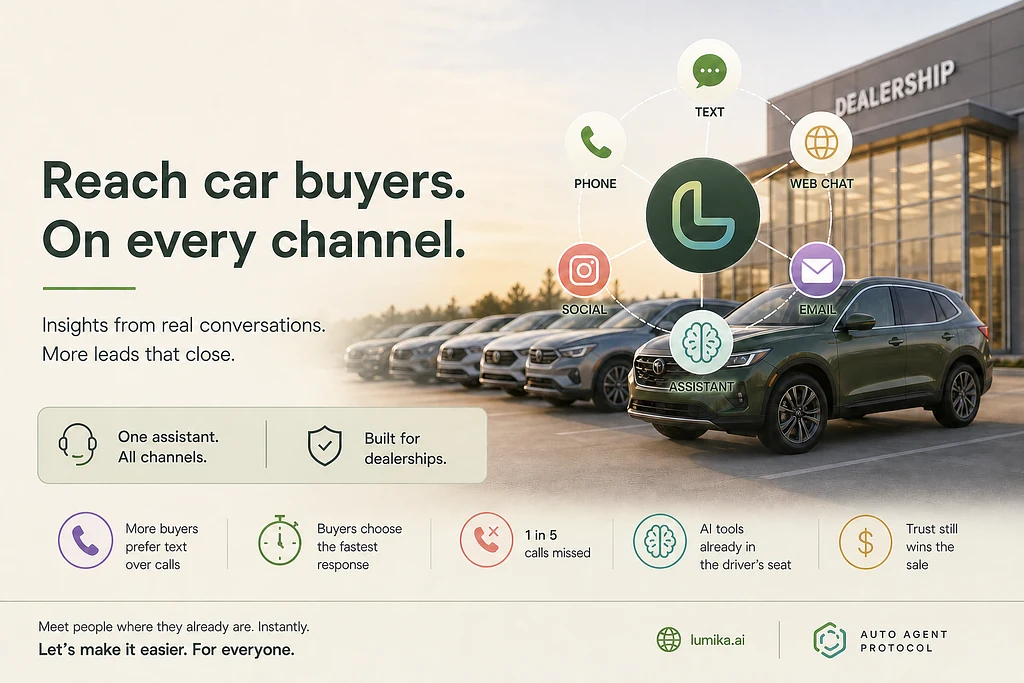
- They reach out across many channels — phone, text, chat, email, social — and expect a real answer on each.
- They abandon any channel that does not respond, fast.
- They want that answer in minutes, day or night.
- They are already shopping through an AI assistant.
- They want an honest price with no surprise fees.
None of that is a phone problem, and none of it is a customer problem. People still want to buy cars — they are just done with friction and dead ends.
So the job splits cleanly into two halves. For every human channel — voice, text, email, web chat, social — the answer is one assistant that covers them all, instantly, 24/7, so no buyer is ever ignored. That is what we build at Lumika. And for the newest channel — the AI assistants your customers already trust — the answer is to let them talk straight to your dealership through the Auto Agent Protocol, which we just took to 1.0 and are opening to the first 1,000 dealerships for free.
Meet people where they already are — their channel, instantly, with a real car and a real price — and the friction disappears. Take the friction away, and buyers are right there waiting.
Let's make it easier. For everyone.
Alex Yankouski
Co-founder, Lumika