What if your AI could actually buy you a car?
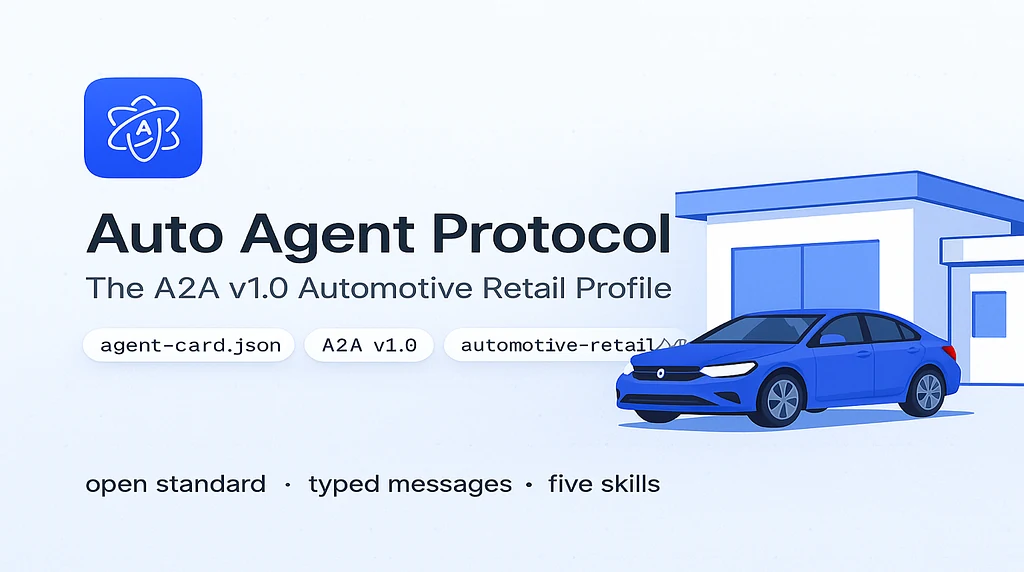
Meet the Auto Agent Protocol — a tiny open standard that lets any AI talk to any dealership in the same language.

Alex Yankouski
Co-founder, Lumika
The problem nobody likes to talk about
Buying a car in 2026 is still weirdly hard.
You open ten browser tabs. Three of those tabs show the "same" SUV at three different prices — and none of those prices are what you'll actually pay at the dealership. You fill out the same lead form six times. Two dealers call you. Four ghost you. The one car you really wanted? Sold this morning, but nobody updated the website.
And here's the part most people don't see: the dealers are frustrated too.
They're drowning in junk leads from twelve different sources, each one formatted differently. Their CRM was built in the early 2000s. Their inventory feed lives in five places at once. When a great customer walks in, they often don't even know which website sent them.
So we have a market where buyers don't trust the prices and dealers don't trust the leads. Both sides lose.
This is the problem the Auto Agent Protocol (AAP) is here to solve.
What AAP actually is (in one sentence)
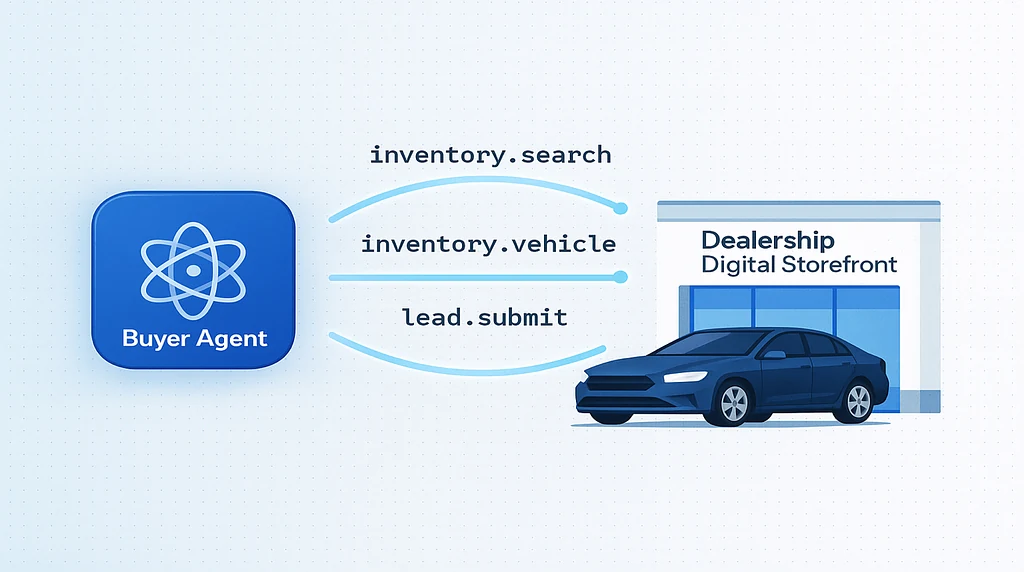
AAP is a small open standard that lets an AI agent — like ChatGPT, Gemini, or a custom shopping assistant — talk to a car dealership using the same words, the same shapes, and the same rules, every single time.
That's it. No new app. No new login. No new portal. Just a shared contract that says: "If you want to ask a dealership about its inventory, here's exactly how the question looks, and here's exactly what the answer will look like back."
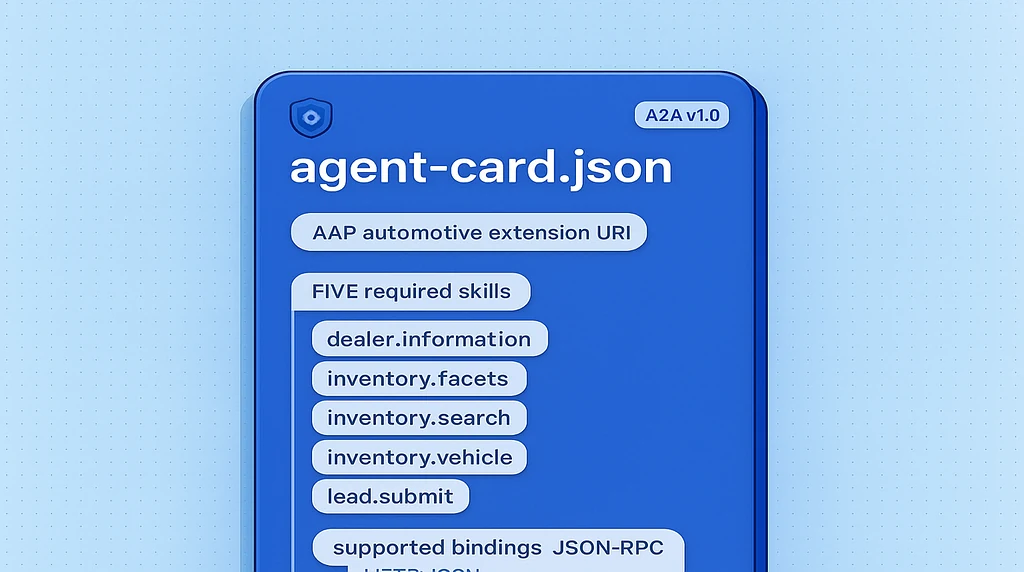
Think of it like the moment USB became a thing. Before USB, every printer had its own cable, every camera had its own cable, every keyboard had its own cable. After USB, one shape worked everywhere. Nobody got excited about USB itself — they got excited about everything they could finally plug in. AAP is USB for AI agents and car dealerships.
The five things AAP lets an AI do
We deliberately kept the first version tiny. Just five skills — five things an AI agent is allowed to ask a dealership.
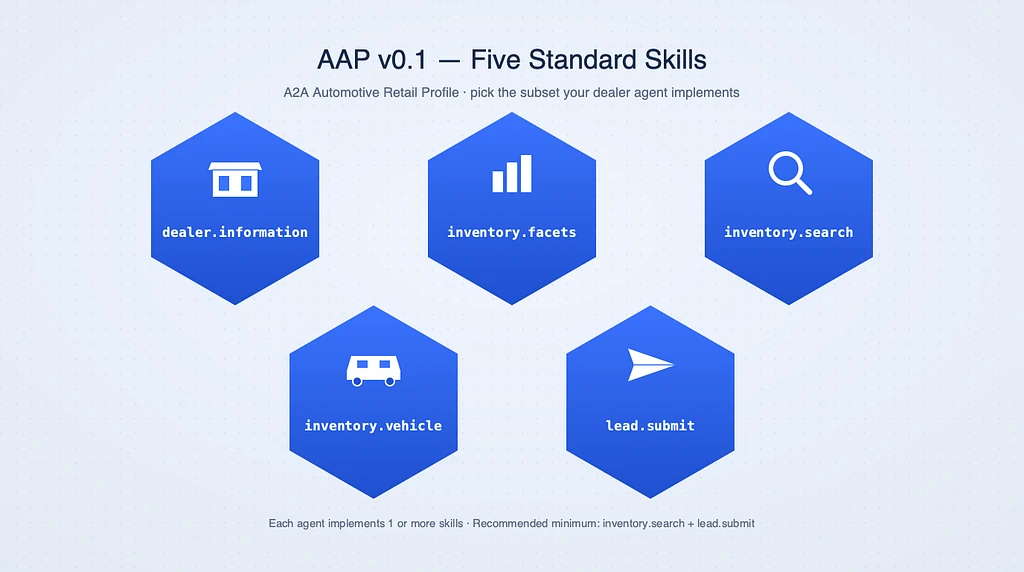
- Who are you? — Tell me about this dealership. Where are you? What hours? What brands?
- What kind of stuff do you have? — Roughly how many SUVs, sedans, trucks? What price ranges? What years?
- Show me cars that match… — Find me a 2022-or-newer Honda CR-V under $30,000.
- Tell me everything about this one car — Full detail on a specific vehicle.
- Here's a real customer who wants to come in — Submit a lead, with consent, with a trade-in if there is one, and/or book a test drive.
That last one — lead.submit — is where the magic happens for both sides of the conversation. We'll get back to it.
Why we're not reinventing the wheel
The world already has a protocol for AI agents talking to each other. It's called A2A (Agent2Agent), and it's the open standard for "how do two AI systems exchange messages over the internet?"
A2A is great — but it's a general-purpose envelope. It tells you how to mail a letter. It doesn't tell you what the letter should say if you're a car shopper writing to a dealership.
That's where AAP comes in.
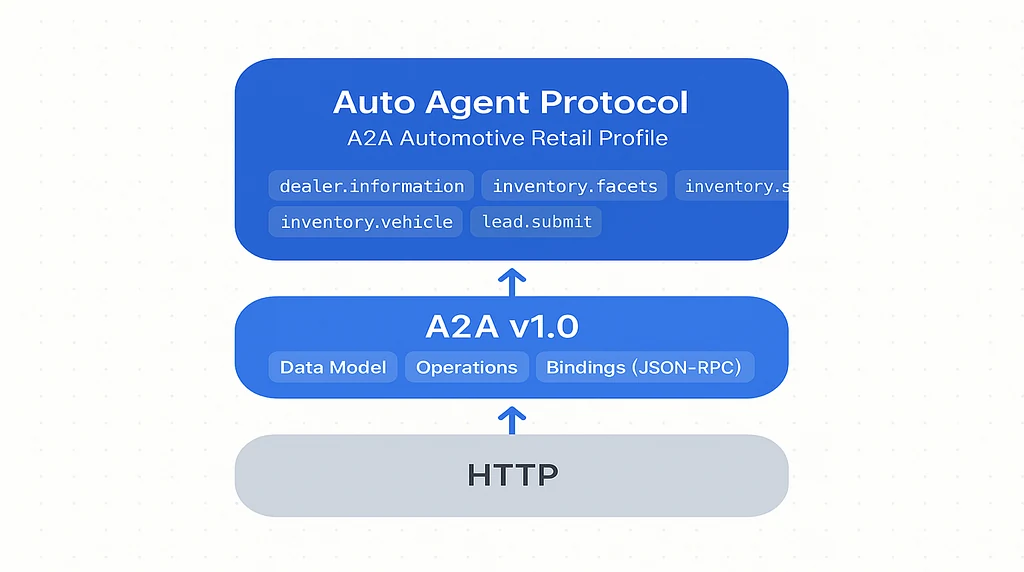
- HTTP is the internet at the bottom.
- A2A is the envelope in the middle — how agents send each other messages.
- AAP is the actual letter on top — written in plain automotive language. VINs. Trims. MSRP. Trade-ins. Appointments. Consent.
We didn't invent the envelope. We just wrote a really clear letter that every dealership and every AI can read the same way.
How it actually feels: a regular shopper's day
Let's walk through what this looks like for a real person who has no idea what an agent protocol is.
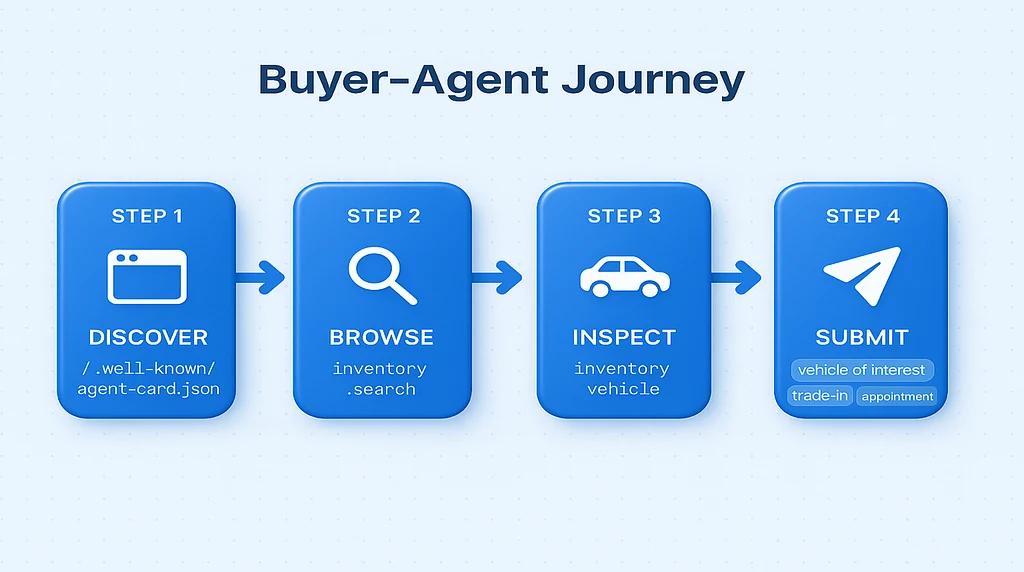
Step 1. You tell your AI assistant: "Find me a used Honda CR-V, 2022 or newer, under $30,000. I want to test drive it this Sunday afternoon and I'd like to trade in my 2020 Passat."
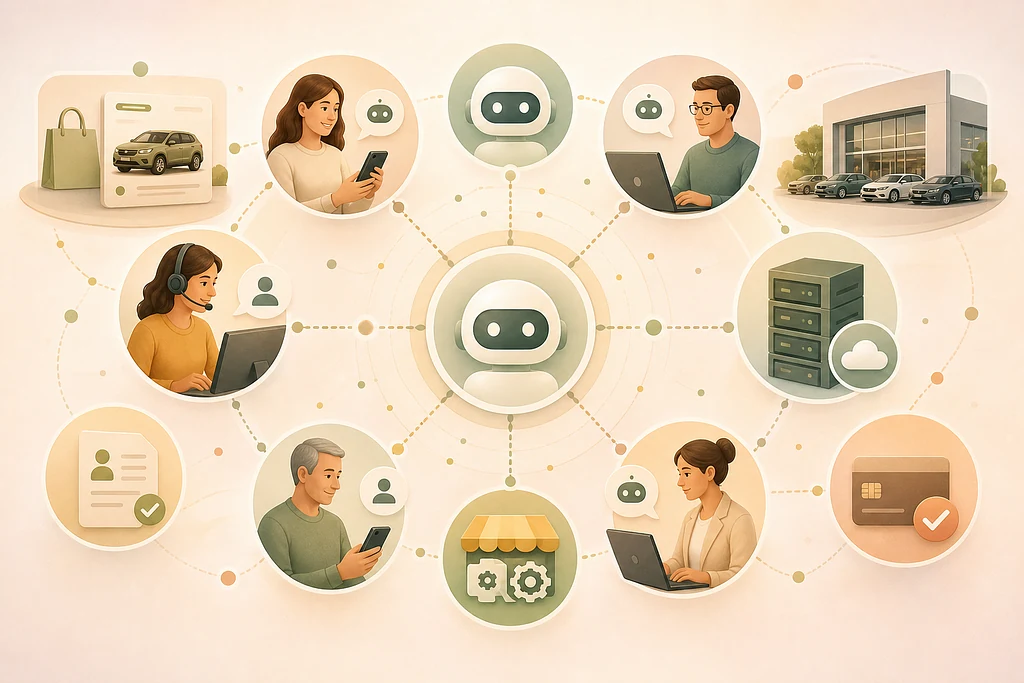
Step 2. Your assistant scans every dealership in the area that speaks AAP. It looks at real inventory — not stale pages from last month. It compares real prices — the kind you'll actually pay, not the kind that vanishes when you read the fine print.
Step 3. Your assistant says: "Here are three matches. The best one is at Demo Toyota, $32,995 out-the-door. Want me to book the test drive and let them know about the Passat?"
Step 4. You say yes. One click. The assistant submits a single, clean lead containing: your name, your real consent (you said yes, in writing, with a timestamp), the specific CR-V you want, your Passat for trade-in, and your preferred Sunday slot.
Step 5. The dealer's CRM rings. Not with a vague form-fill, but with a real, ready-to-work customer.
That's it. The friction is gone. And critically — nobody had to build a custom integration for any of this. The dealer didn't write code for ChatGPT. ChatGPT didn't learn the dealer's website. They both already spoke AAP.
The four things that make AAP genuinely different
Anyone could've written "a JSON format for car listings." Plenty of people have. What makes AAP worth caring about is what we built into the contract itself.
1. Honest pricing is required — by the protocol
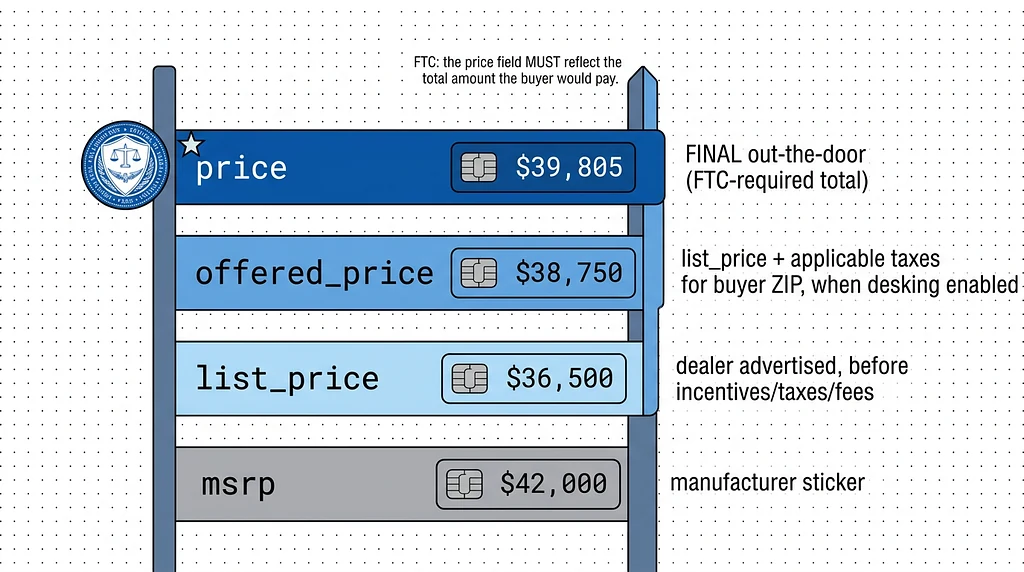
Every car in AAP has up to four price fields, and we are blunt about which one matters:
- msrp — the sticker price from the manufacturer (usually for new vehicles)
- list_price — the dealer's advertised base price
- offered_price — adjusted for your local taxes
- price — the FTC-final, out-the-door, "this is what you actually pay" number
That last one is non-negotiable. In March 2026, the FTC sent warning letters to 97 dealership groups about deceptive pricing — the classic trick where an ad shows $24,995 and the contract somehow says $31,400.
AAP makes that trick structurally impossible for any agent that uses the protocol. The field is named price and it MUST be the final number. If a dealer publishes anything else there, every buyer agent on earth will surface their car as artificially cheap, and the dealer ends up advertising a deceptive price across the entire AI ecosystem.
Honest pricing isn't a feature. It's the floor.
2. Consent is built into the lead — not bolted on
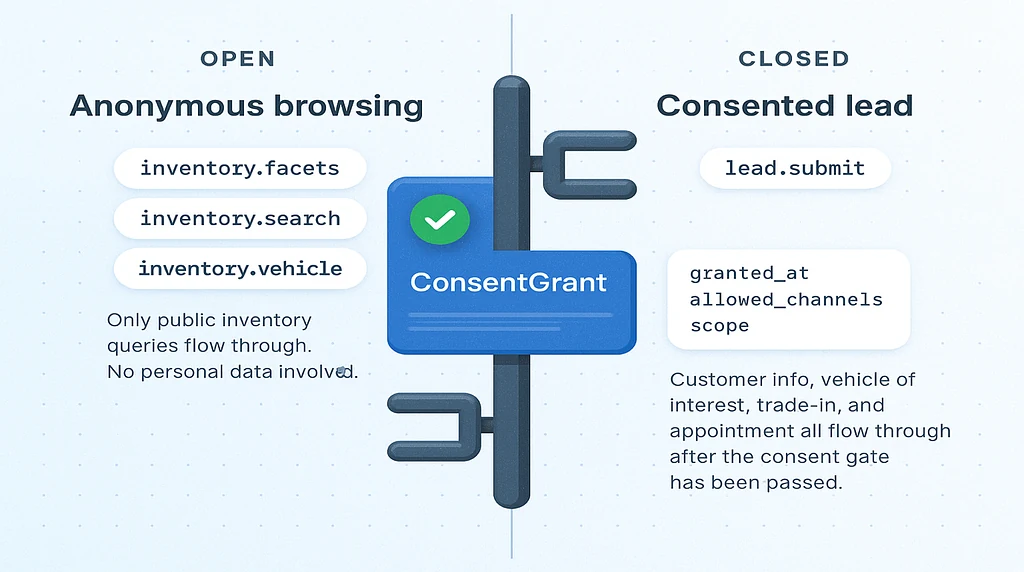
You cannot submit a lead in AAP without an attached ConsentGrant. The contract literally won't validate.
The consent grant says, in writing:
- When the customer agreed (timestamp).
- What channels they agreed to (phone? email? text? all three?).
- Which AI agent captured the consent.
- The exact words the customer agreed to.
This means TCPA, CAN-SPAM, and state privacy laws are easier to follow, not harder. Dealers stop wondering whether they can legally call this lead. Customers stop getting calls they didn't ask for. The protocol enforces it.
3. One unified lead — vehicle + trade-in + test drive in a single shot
The way leads work in most CRMs is painful: one form for "interested in a car," another for "trade-in appraisal," a third for "book an appointment." Three forms, three follow-ups, three chances for something to get lost.
AAP collapses all of that into a single lead.submit. One request can carry:
- The customer (who you are)
- The consent (what you said yes to)
- The vehicle of interest (what you want to buy)
- The trade-in (what you want to sell)
- The appointment (when you want to come in)
That's how real shoppers actually behave. "I want to test-drive this CR-V on Sunday and have my Passat appraised in the same visit." One sentence from the buyer should be one request to the dealer. Now it is.
4. It works with the dealer's existing CRM — day one
Here's the unglamorous detail that makes this whole thing realistic.
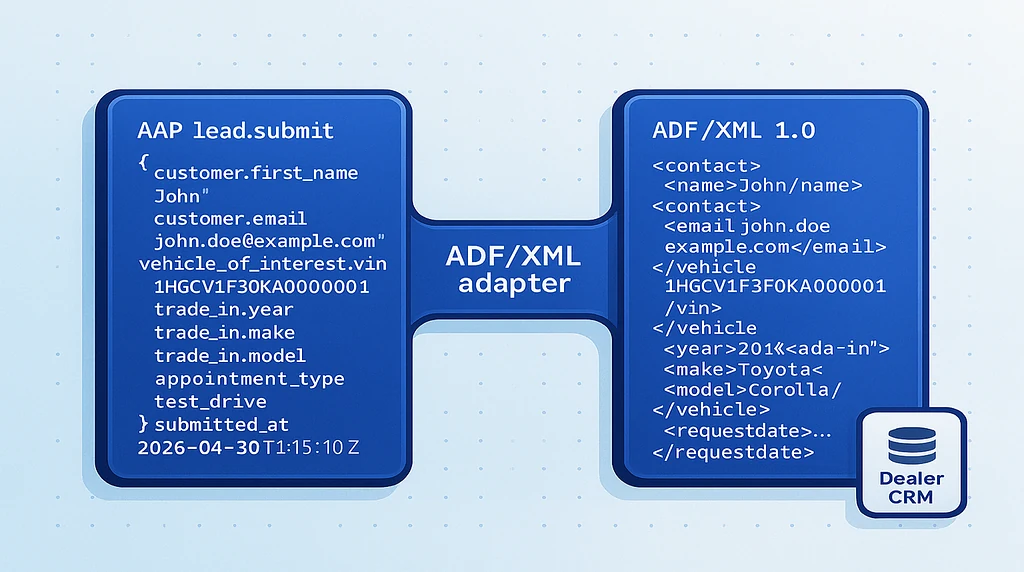
Dealer CRMs have ingested leads via a 25-year-old format called ADF/XML for two decades. Every company in the automotive industry — Lumika, Space Auto, VINCUE, Reynolds, CDK, VinSolutions — already speaks it.
So we made sure every AAP lead can be losslessly converted to ADF/XML. Field by field. No translation loss. No "we'll get to that integration in Q4."
That means a dealer can adopt AAP without their CRM vendor lifting a finger. The lead arrives in AAP, gets translated on the way in, and lands in the CRM looking exactly like every other lead the staff already processes.
This is, I think, the single most underrated piece of AAP. You can't change an industry by ignoring its legacy. You change it by making the new thing speak the old thing's language fluently.
What it means for buyers
- You get real prices, not bait prices.
- You get real-time inventory, not yesterday's website.
- You give one consent, once, for one scoped purpose — not a six-page checkbox marathon.
- Your AI of choice — ChatGPT, Gemini, Claude, the custom assistant on the dealer's site — sees the same information you do, in the same format, from every dealership it talks to.
- You can compare twelve dealers in the time it used to take to compare two.
- You stop being the data-entry intern in your own car-buying process.
What it means for dealers
This is the part I most want my dealer friends to hear.
- Cleaner leads. Every lead arrives structured, validated, with consent attached, ready for your BDC to call. No more sales staff guessing whether the email address is real or whether they can legally text the lead.
- No custom integrations for every new AI assistant. ChatGPT launches a shopping mode? Gemini launches one? A startup launches one? If they speak AAP, you're already integrated. You don't write code per partner.
- Your CRM doesn't change. AAP leads come in as ADF. Same workflow. Same screens. Same training.
- Honest pricing protects you. If your competitor down the street is publishing the deceptive bait price, the FTC is now sending warning letters and AAP-aware agents will surface and rank against the final price anyway. Playing it straight stops being a disadvantage.
- Your inventory finally reaches AI shopping assistants in a way that they can actually read, sort, and recommend. Right now, when an AI looks at the dealership world, most of it is invisible because it's locked in proprietary feeds. AAP makes you visible.
Why open, why now
This is an open protocol. The spec, the JSON schemas, the validators, the TypeScript SDK — all of it lives in the open. Anyone can read it, implement it, propose changes, or build on top of it.
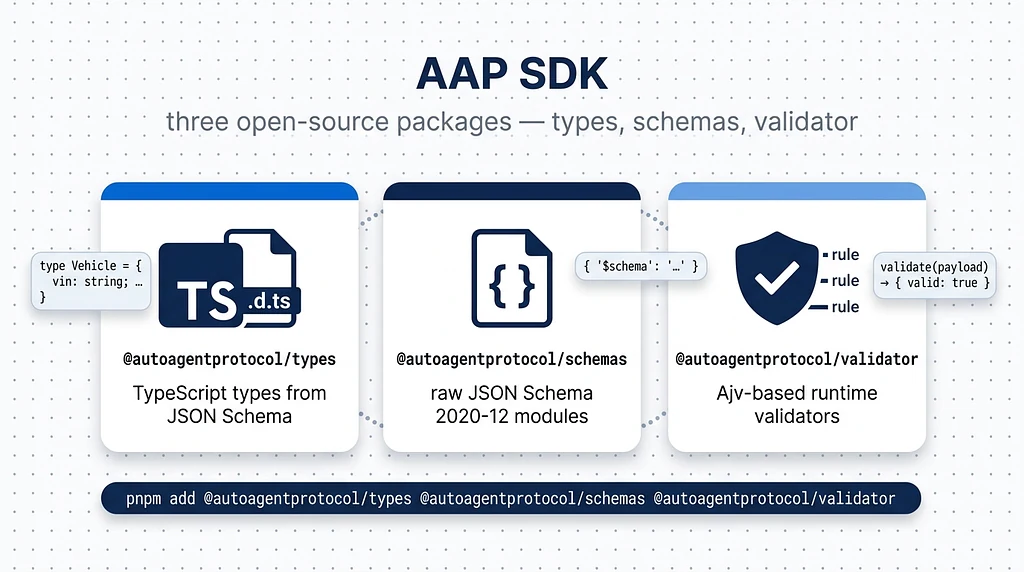
The reason it has to be open: no single company owns the rulebook for how AI talks to cars. Not OEMs. Not CRM vendors. Not aggregators. And certainly not any one AI lab. The only way buyers and dealers both win is if the contract belongs to the whole industry.
We started this work because we sit on both sides of the table at once. Space Auto builds the websites, digital retail tools, and CRM software dealerships actually use. Lumika builds AI agents that talk to dealerships every day. We see both pains. We have a strong opinion: the way to fix automotive is to write a small, clean, opinionated contract — and give it away.
What's not in v0.1 (yet)
Honest list, because this matters:
- No payments. AAP doesn't try to be the cart and checkout protocol — that's Agentic Commerce's job. Cars are rarely transacted purely online anyway.
- No financing approval flows.
- No formal trade-in valuations. You can submit a trade-in, but the dealer's appraisal still happens off-protocol.
- No reservations. You can ask to test-drive a car. You can't yet "hold" it.
- US-only addressing for v0.1. International addressing comes in a later version.
We chose narrowness on purpose. Five skills, done right, is more useful than fifty skills, done vaguely. The next versions will expand the surface — but only after the foundation is rock solid and real dealers are running on it.
How to get involved
- Read the spec: Auto Agent Protocol
- If you're a dealer or DMS/CRM vendor: start with
agent-card.json, then addinventory.search+lead.submit. That's a working AAP dealer agent. - If you're building an AI shopping assistant: the buyer side is just two calls — discover the agent card, send AAP-typed messages over A2A. Identical payloads work across every compliant dealer.
- If you just want to follow along: star the repo, watch for v0.2, and reach out — we want feedback from real shoppers and real dealers.
The bigger picture
For most of the last twenty years, every improvement in automotive retail has been "let's build a slightly better website" or "let's add another widget on the SRP." Real progress has been incremental and mostly cosmetic.
AI changes the shape of that. The next interface between a car shopper and a dealership isn't going to be a website at all — it's going to be a conversation, and one side of that conversation is going to be an AI assistant.
The question is whether that future is open or closed. Whether one company owns the bridge, or whether the bridge belongs to everyone.
AAP is our bet on transparency. A small contract. Clear rules. Honest prices. Real consent. Works with the CRMs dealers already have. Plays nicely with every protocol that already exists.
If we get this right, buying a car in 2030 looks nothing like buying a car in 2025 — and dealers will be just as happy about that as buyers are.
Let's make it easier. For everyone.
Alex Yankouski
Co-founder, Lumika